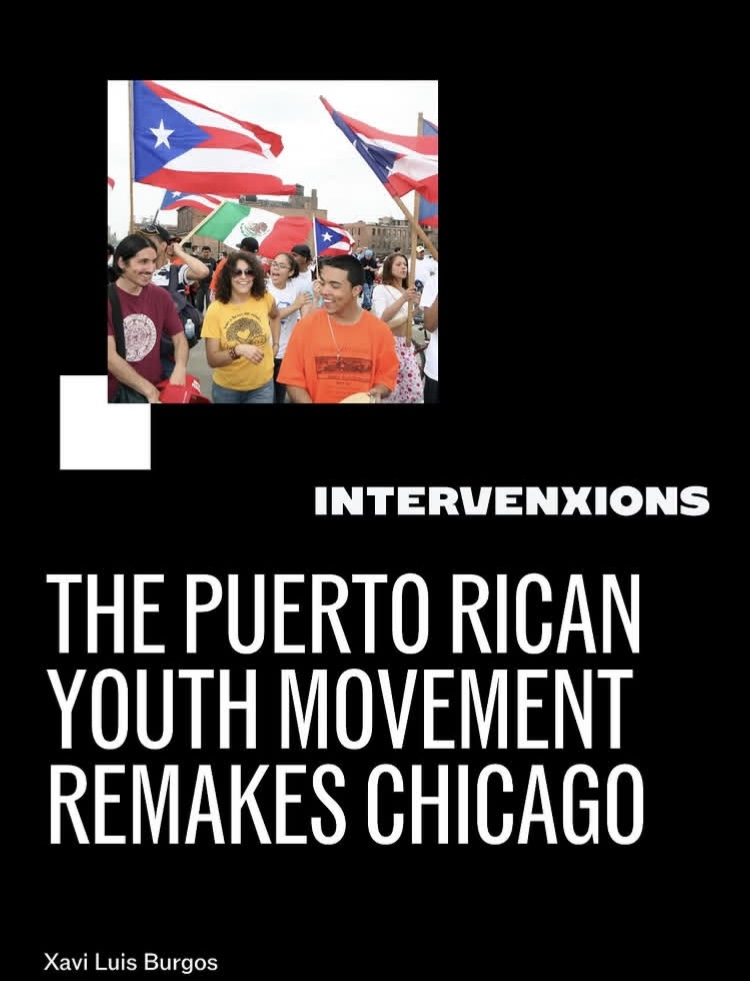
Published at Intervenxions. Read full essay, here:
….A dozen youth dressed in black walk silently through campus at its busiest hour. Some lend their shoulders to carry a long coffin, while others lift hand-painted and printed signs. The procession swerves through the indoor quad, passing hundreds of students shuffling to class. Participants solemnly distribute small red leaflets. The energy shifts in the dark basement computer lab to the sounds of flipping paper and hurried steps. Some stop their studies to read the meaning of this radical pageantry:
We want amnesty for undocumented immigrants. A borderless society. Stop United States military intervention in Latin America. Stop the wars in Iraq and Afghanistan. Free the Puerto Rican political prisoners. Independence for Puerto Rico.
This was the fall of 2005. The group tirelessly assembled text, bodily adornments, and art works the night before at Café Teatro Batey Urbano, a former organizing arts hub that started in 2002 by youth of the Puerto Rican Cultural Center. Conversation sparked around barrio life and ideas of homeland. These working-class youth were members of the Union for Puerto Rican Students (UPRS), Que Ondee Sola (QOS), and the Chica@ Mexican@ Latin@ Student Union (ChiMexLa), all founded at Northeastern Illinois University (NEIU) decades before.
A recent summer trip to the 16th World Festival of Youth and Students in Caracas, Venezuela, invigorated many members. After weeks of intense fundraising, dozens of youth from Chicago’s Puerto Rican, Dominican, and Mexican West and South sides joined thousands in Hugo Chávez’s new Bolivarian Revolution. The gathering resulted in the erosion of thinking of a bicameral world—a wealthy imperial North and an impoverished colonized South. Youth quickly connected with organizers in Caracas’ historic barrios, exchanging visions of liberation and detailing efforts in Chicago’s Latine hoods. By the time the school year began, they were prepared to make official institutions value this knowledge and experiences.
NEIU was then, and now, an institution promoting stability and social mobility to the city’s working and middle classes. It is the alma mater of tens of thousands of educators. As it were, the battles at NEIU were reflective of those rooted in the city, where Puerto Rican, Black, and Mexican youth disrupted beliefs in the “American Dream,” or gaining wealth and status through assimilation or racism.
Latine politics-in-the-making was instead presented that afternoon on campus. Rather than a meshing of identities for just joy and entertainment, Latine was reaffirmed as a phenomenon of organizing for each other’s struggles. The action asserted that Chicago Latinidad was a demonstration of art and agitation for linked concerns, with specifically named places and histories to fight for.
Since the foundational Young Lords Organization, New York’s Young Lords Party (YLO), the Illinois Chapter of the Black Panther Party, and the Movimiento de Liberación Nacional, for many youth “Black” and “Latine” were coded language for coalitions of a joint revolution. This funeral procession for Latin America, México, and Puerto Rico indeed stood in a legacy of many past creative interventions but boldly marked a definable new beginning of a new generation seeding our current world.
All this is the direct result of the youth reclaiming and remixing an inheritance of struggle for a Chicago with them firmly directing its future. For that to be, it was necessary to practice solidarity with Black, Mexican, Dominican, and working-class, leftist white residents. It meant provoking attention to the political visions of young people cultivating identities to build a new society. The 21st-century barrio-hood, queer and trans, Afro and Indigenous; and women and femmes of Puerto Rican Chicago reclaimed past presences of kinship and carried out new demands.
In spring 2007, youth from the most active and rebellious organizations at NEIU quickly filled the basement office of Que Ondee Sola, a Puerto Rican and Latine magazine founded in 1972. It was at the same hour as the official forum for a proposed multicultural center. Members of UPRS, QOS, and ChiMexLa had entered the large study hall and loudly announced both their opposition and an invitation.
The Black Student Union, Justice Studies Club, socialist students, Latine fraternities and sororities, such as Alpha Psi Lambda; and Movimiento Cultural Latino Americano exploded the small room with passionate debate. One attendee pointed out there already was a student-led center created by ethnic coalitions, namely Albizu-Zapata Portable 1, demolished in 1982 by the university after a decade of use. Others raised worry that opposing a multicultural center may result in none at all. Emotions ran high on the risk of exclusionary nationalisms and the needs of each ethnic group on campus. Some proposed a specific and connected Latina/o Cultural and Resource Center and Black cultural center. Many stressed that this was an opportunity to remake the university.
Later, the director of the Center for Inner City Studies—one of the university’s campuses in the heart of Bronzeville, an historic Black community —supported the organizing of Puerto Rican and Mexican youth. The new governor appointed to the Board of Trustees a former leader of UPRS and QOS. The new university president appointed as its diversity, inclusion, and compliance officer a veteran of HIV and LGBTQAI organizing through ACT-UP and Vida/ SIDA. Members of UPRS and QOS quickly met with them and local Puerto Rican elected officials, to push for a Latina/o Cultural and Resource Center.
After years of forums, meetings, and fights over budgets and student inclusion, in 2009, the Illinois legislature approved funds. In 2011, NEIU inaugurated the Angelina Pedroso Center, housing Latine, Black, Asian, and Women-centered cultural centers. The Latin American and Latino Studies minor became a major—another student demand. The university later rebuilt a monumental El Centro, its community campus in a Northwest side Puerto Rican and Mexican neighborhood…..
 Xavi Burgos